
Track how champion odds move in real time, find where bookmakers undervalue a contender, and see which dark horses carry the strongest case. Updated throughout the tournament.
Pre-draw price vs current price. Arrows show 7-day movement direction.


Pre-draw prices sourced from major bookmakers prior to group stage draw. Current prices as of June 11, 2026. Drifted = odds lengthened (less favoured); Shortened = odds tightened (more favoured).
Every set of odds contains a hidden win probability: odds of 5.00 mean the bookmaker believes a team has a 20% chance of winning. We compared those figures against our own calculation based on form, FIFA ranking and bracket difficulty. Where our number is higher, we flag it as VALUE — the bookmaker is underrating that team and you are getting a better price than the real chances justify.
BrazilGermanyEnglandFranceArgentinaSpainThree teams where the case for an outright run is stronger than the odds suggest.

Morocco's semi-final run at Qatar 2022 was not a fluke. They became the first African nation to reach the final four of a World Cup, eliminating Spain and Portugal on penalties along the way. The core of that squad — Hakimi, Amrabat, En-Nesyri — returns four years older and significantly more experienced at this level.
The challenge at this tournament is a Group C draw with Brazil, but Morocco's defensive structure is built precisely to neutralise technically superior opponents. They conceded just three goals across six knockout-stage matches in 2022, all in the third-place play-off. As a group runner-up they would face the Group F winner (likely Netherlands) in the Round of 32 rather than a Brazilian rematch — a bracket path that keeps the hardest fixtures until the quarter-final stage at the earliest.

No host nation has failed to reach the knockout rounds of a World Cup since South Africa in 2010, and the USA carry far more quality than South Africa did. The Pulisic–Reyna–McKennie generation is at peak age in 2026, with most of the starting XI based at top European clubs. More importantly, they will play the majority of their matches at venues they know — MetLife, SoFi, AT&T — in front of crowds of 70,000 to 100,000.
Group D alongside Paraguay, Australia and Turkey is genuinely winnable. The USA has not reached a World Cup semi-final since 2002 on home soil in Korea/Japan. The parallels are obvious: host advantage, a squad peaking at the right moment, and a fanbase that converts crowd atmosphere into measurable home advantage. At 21.00 they represent the best value of any host nation in recent tournament memory.

Colombia entered the 2024 Copa América as one of the least-fancied sides and left as the team that went 28 matches unbeaten — the longest unbeaten run in their history — before losing the final to Argentina on a James Rodríguez assist that set up the winning goal. They played attractive, high-intensity football throughout and were arguably the best team at that tournament on the basis of expected goals and chance creation.
Luís Díaz (Liverpool) and James Rodríguez are the creative spine, but the real story is the depth of talent across the squad — Jhon Durán, Jhon Córdoba, Richard Ríos. Group K with Portugal, Uzbekistan and Jamaica is the most favourable group draw a South American side received. If Colombia qualify as group winners they avoid Portugal until the quarter-finals at the earliest. At 29.00 they are longer than Belgium, who have not improved on their 2018 third place in the five tournaments since.
This page exists for one specific type of World Cup fan: someone who wants to back a team or a player to have a great tournament before the story fully unfolds. Futures betting is fundamentally different from placing a bet on tonight's match. When you bet on a match result, you know the teams, the form, the stakes, and the context — the market is efficient because the information is complete. When you bet on a tournament winner or a top scorer before the group stage is over, you are working with incomplete information, and that gap between what the market knows and what the market does not yet know is where the interesting decisions live.
The purpose of this page is to make that gap visible. The Market Pulse section shows you how champion odds have moved since the groups were drawn — which teams the market has grown more confident about, and which ones the money has drifted away from. The Value Finder section shows you where our calculation of each team's real probability differs from the probability hidden inside the bookmaker's price. The Dark Horse Index gives you three teams where the argument for a deep run is stronger than the odds suggest, with the specific reasoning laid out rather than just a number.
None of this tells you what to bet. It tells you what the market currently believes, where it might be wrong, and which storylines from this tournament are generating the most interesting long-term opportunities. What you do with that information is entirely up to you.
A common mistake in futures betting is treating the first price you see as the only price available. Bookmakers set their own odds independently, and on outright markets — which are less liquid than match betting markets — the differences between platforms can be significant. The difference between odds of 6.50 and 7.50 on the same team winning the tournament is not cosmetic. On a $100 stake, it is the difference between a $650 return and a $750 return. Across a full tournament with multiple futures positions, the cumulative effect of accepting inferior prices is substantial.
Comparing data also protects you from the most common distortion in futures markets, which is the celebrity premium. Teams like Argentina, Brazil, and France attract disproportionate recreational betting activity because they are well-known names. That public money compresses their odds below what the underlying probability justifies — which is precisely why Argentina currently trades at 6.50 despite our model rating them at 13.0% (implying a fair price of around 7.70). Bettors who do not compare the bookmaker's implied probability against an independent estimate are systematically accepting worse prices on the most popular selections.
The comparison logic works in both directions. Germany at 10.00 carries an implied probability of 10.0%, but our model rates them at 13.0% — meaning the odds are currently more generous than the real chances justify. That gap exists because Germany's poor group stage exits at the 2018 and 2022 World Cups are still weighing on the market's perception, even as their squad has undergone a significant renewal under Julian Nagelsmann with a younger generation led by Florian Wirtz at its creative centre. The data comparison makes that discrepancy visible in a way that simply looking at the odds does not.
We reviewed eight bookmakers across the criteria most relevant to futures betting specifically — not general sportsbook quality, but the characteristics that matter when you are placing a long-term wager on a tournament outcome. Those criteria are: depth of outright markets, odds competitiveness on champion and top scorer markets, platform stability over a five-week window, withdrawal speed for settled futures bets, and the promotional structure surrounding the tournament.
BetFury performed strongest across all five categories. On outright depth, BetFury covers all 48 qualified nations with pre-match and live markets, which is not universal — several competitors limit their outright listings to the top 20 or top 30 in the championship market and offer nothing on the remaining teams. This matters for futures bettors interested in value selections further down the market, including the dark horse picks featured on this page. On odds quality, BetFury's champion market prices are consistently competitive across both the favourites and the mid-range contenders, without the wide margins that some crypto-native books apply to outright markets to compensate for lower liquidity.
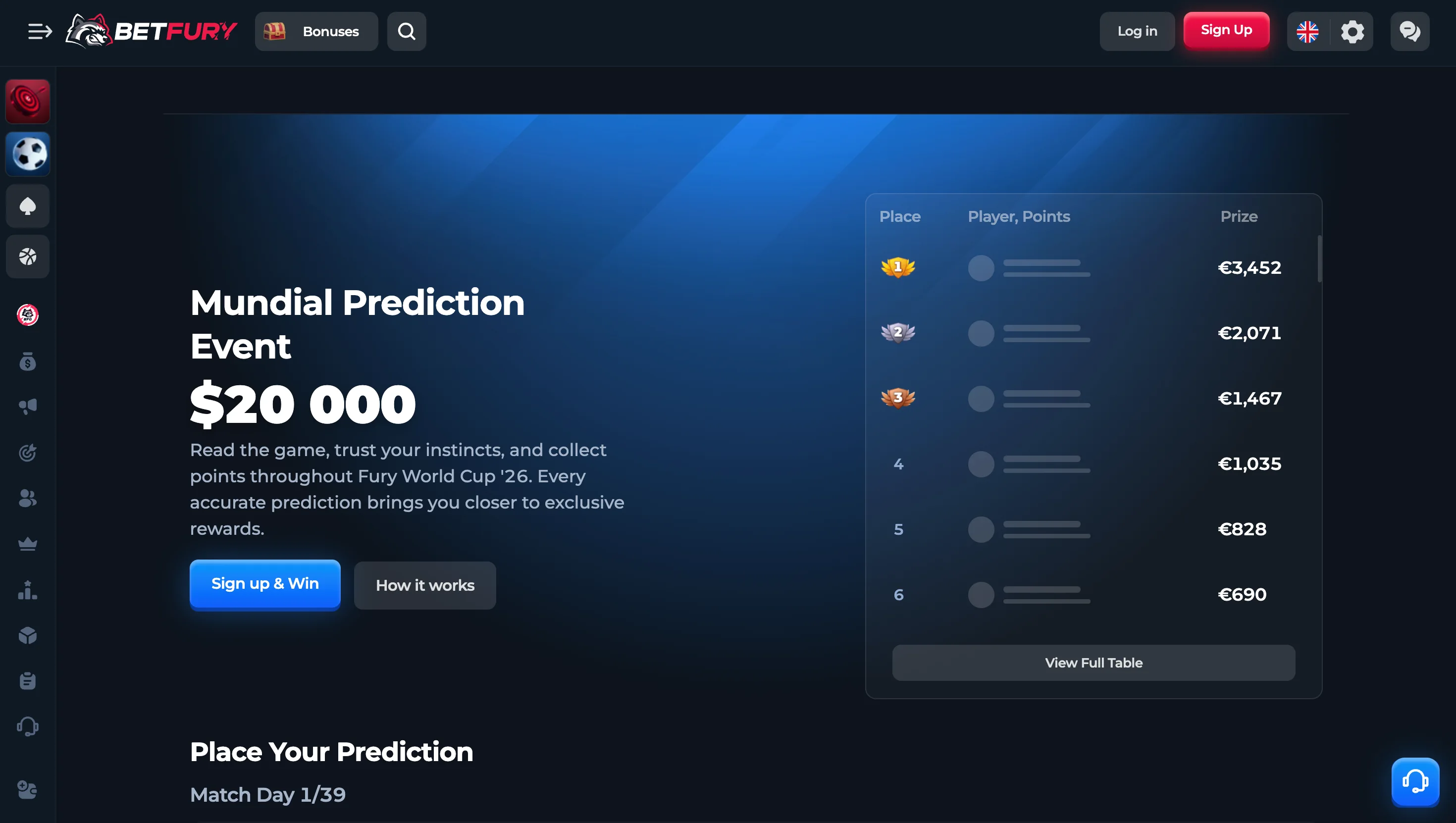
The platform stability question is particularly important for futures bettors. A match bet settles within 90 minutes. A tournament winner bet is live for five weeks, across 104 matches, through knockout rounds and high-traffic peak moments like the quarter-final and semi-final evenings when simultaneous usage spikes. BetFury's infrastructure is built on a provably fair, on-chain architecture that has demonstrated consistent uptime across previous major tournament windows, and the bet history is independently verifiable rather than relying on the platform's own records.
The Fury World Cup '26 promotional structure is the final differentiator. The $600,000 guaranteed prize pool, the Championship Battles format, and the Trophy Prediction Outrights free bet offer are all structured around tournament betting activity — meaning bettors who are already placing futures wagers on World Cup outcomes receive additional promotional value on top of their standard returns. No other bookmaker in our review combined competitive outright pricing with a tournament campaign of this scale and a promotional structure that directly rewards futures market activity rather than focusing exclusively on match-by-match volume.
The data on this page will be updated as the tournament progresses and the odds landscape changes. The most significant shifts in futures markets typically happen at three points: after the final group stage matchday, when the Round of 32 bracket is set and the path to the final becomes concrete; after the Round of 16, when the quarter-final lineup is confirmed and outright odds compress sharply around the surviving teams; and in the 48 hours before each knockout match involving a championship favourite, when pre-match money moves the prices in both directions.
The Value Finder section is most useful early in the tournament, when the market's information is least complete and the gaps between implied and modelled probability are widest. The Dark Horse Index will be updated after each knockout round to reflect whether the original cases remain intact or have been strengthened or invalidated by results on the pitch. The Market Pulse sparklines will extend as more data points accumulate, making the directional movement of each team's price clearer over time.
If you are considering a futures position, the best approach is to use this page to identify the selections where the combination of market odds, our modelled probability, and the narrative case align — and then compare the available prices across the bookmakers listed in the sidebar before placing the bet. The combination of those three inputs — price, probability, and story — gives you a more complete picture than any single data point alone.